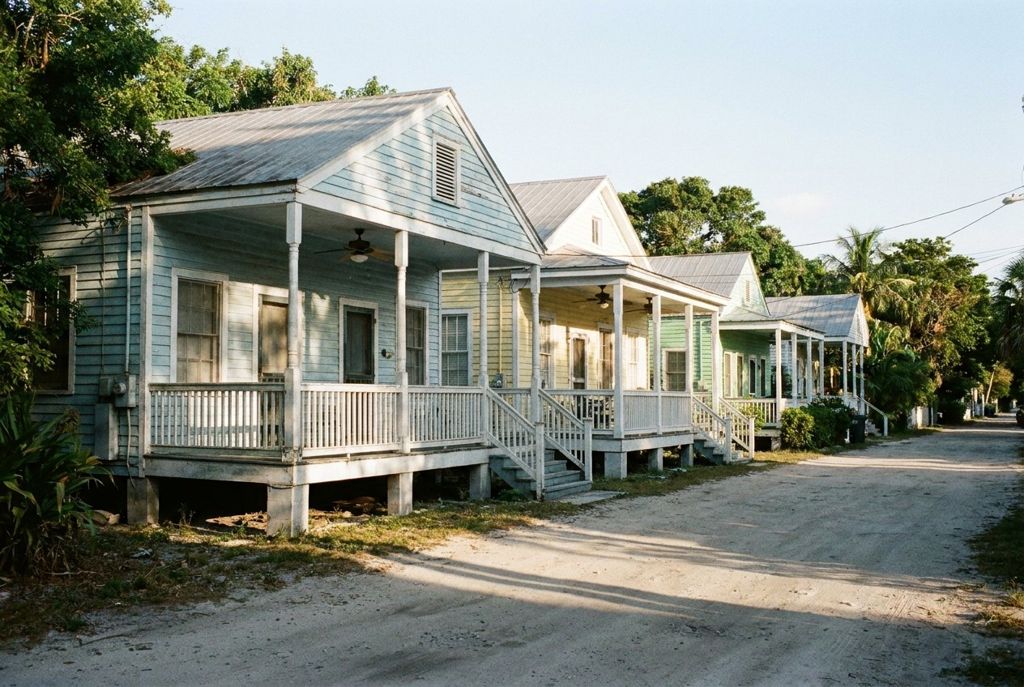
Between St. Claude Avenue and the river, the oldest part of the Lower Ninth keeps its shotgun houses, raised cottages and two riverboat-shaped homes that people have stopped to look at for a century.
- Ride
- An hour or two
- Surface
- Narrow streets, uneven pavement
- Best months
- October through April
- Getting there
- South of St. Claude, toward the river
- Bring
- Water, a lock, a camera used kindly
Heads up: The Steamboat Houses are private homes with people living in them. Stop on the street, look and photograph from there, and never ride onto the property or block a driveway.
Holy Cross is the river side of the Lower Ninth Ward, the band of streets between St. Claude Avenue and the Mississippi levee. It is older than most of the ward north of St. Claude, and because the ground is a little higher near the river, more of its old houses came through the 2005 flood. On a bike it is a slow, close ride: short blocks, narrow streets, and a house worth noticing on nearly every corner.
A district with a name
The neighbourhood takes its name from Holy Cross School, the Catholic boys' school whose campus stood here by the river for generations. After the 2005 storm the school moved to another part of the city, and the old riverside grounds have changed since, with some buildings kept and others gone. Ride past and you will see the scale of what was here, but treat the site as private property.
Much of the area is listed as the Holy Cross Historic District. That listing recognises the houses as a group: the way the blocks hold together, rather than any single grand building. It is a working neighbourhood, not a museum, and the best way to appreciate it is to ride its streets one by one.
Shotguns and raised cottages
The house you will see most often is the shotgun: one room wide, several rooms deep, set close to the street, with a short porch and a front gable or a hipped roof. Some are singles, one household's worth; others are doubles, two shotguns side by side under one roof with two front doors. Look for the details builders added to plain frames: turned columns, brackets under the eaves, patterned woodwork above the porch.
Mixed among them are raised cottages, lifted a few steps above the ground on piers, with wide front galleries. Raising a house was a sensible answer to a damp, low city long before modern flood rules made it common again. Here and there you will also see newer homes built after 2005, lifted much higher still. Seeing the old and new side by side tells part of the ward's story without a word.
Colour is part of the pleasure. Owners paint their houses in strong blues, greens, yellows and pinks, often with trim in a contrasting shade, and many porches carry plants, chairs and the small personal touches of people who sit out in the evening. Ride slowly enough to notice, but remember that a porch with someone on it is a living room in the open air. A nod and a hello are the right response, not a lens.
Pairs well with: The river levee and the Bayou Bienvenue platform
The Steamboat Houses on Egania Street
Near the levee, on Egania Street, stand the two houses most visitors to Holy Cross come to see. They are known as the Doullut Steamboat Houses, built in the early 1900s by the Doullut family, whose working lives were tied to the river. The first was built for a riverboat captain; the second, a few years later, was built along the same lines for his son.
Both houses look as if a river steamer had come ashore and decided to stay. Wide wraparound galleries circle the main floors like the decks of a boat. Railings are strung with rows of turned wooden balls that read from a distance like strings of beads. On top sits a small enclosed room with windows on all sides, much like a pilothouse. The roofs have a gentle, upturned look that is often said to draw on Japanese design, popular in America at the time they were built.
They are among the best-known houses in the ward and are recognised as historic landmarks, but they remain private homes. Look from the street, keep to the roadway, and move on so the next visitor, and the people who live there, have room.
A slow route through the district
Holy Cross is small enough to ride in an hour and pleasant enough to fill two. A simple way to see it:
- Turn off St. Claude onto any street toward the river and ride down to the levee.
- Ride along the streets parallel to the river, such as Dauphine and Royal, zigzagging back and forth across the district.
- Stop on Egania Street for the Steamboat Houses, close to the levee end.
- Walk your bike up onto the river levee for the view upriver to the downtown skyline.
Streets here are narrow, with cars parked on both sides, so ride steadily and watch for doors opening. Some pavement is in poor shape, with sunken patches and loose gravel near the curbs.
Where this fits in a longer ride
Holy Cross makes a natural first half of a day in the ward. From the levee end, ride north along Caffin Avenue and you leave the old houses behind for the open blocks closer to the bayou, the part of the ward the flood hit hardest. The contrast is sharp, and it helps to know the history first; the story after the water covers it plainly.
If you are crossing from the Bywater, the first loop through the ward starts here too. Either way, come early, before the sun gets high, and give yourself time to look closely. The houses repay it.