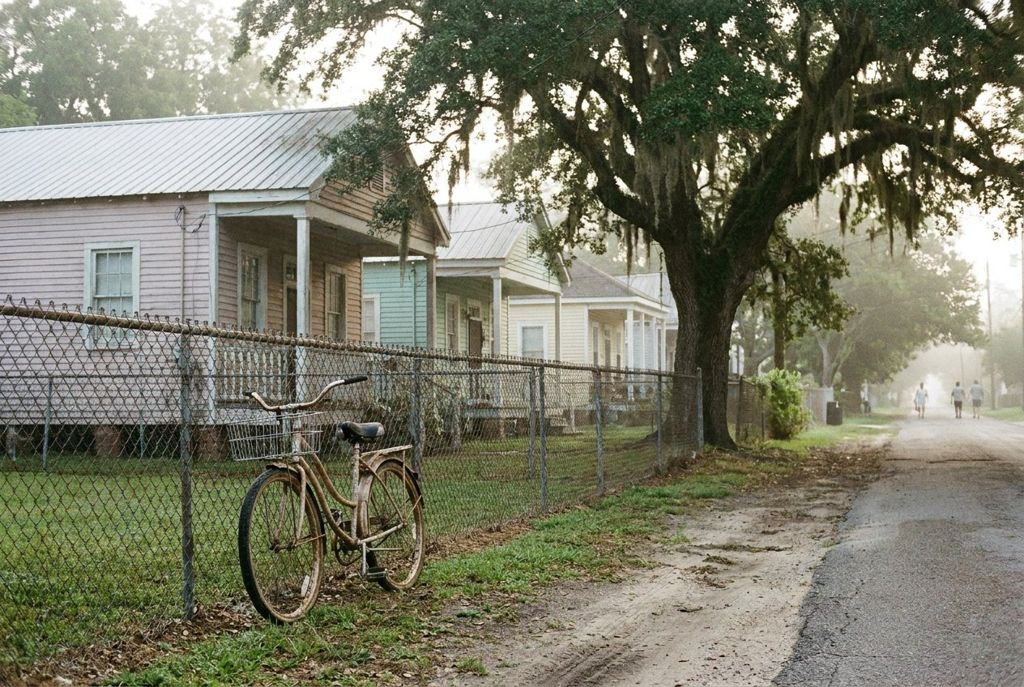
A flat, quiet corner of New Orleans below the Industrial Canal, best seen slowly from a bike seat: how to get across the water, how the streets fit together, and a loop to begin with.
- Ride
- About 6 to 8 miles, flat
- Surface
- City streets, potholes, some broken pavement
- Best months
- October to April
- Getting there
- Across the Industrial Canal from the Bywater
- Bring
- Two full water bottles, a lock, sunscreen, patience
Heads up: Start early. By late morning the sun is hard on open blocks with few trees, and the shade that does exist is mostly on the river side, in Holy Cross.
The Lower Ninth Ward is one of the easiest parts of New Orleans to ride and one of the least understood. The land is flat, the traffic on most streets is light, and the distances are short. What takes time is reading the place: a neighbourhood of long-rooted families, empty lots where houses once stood, new homes raised high on piers, and a history that the 2005 flood made known around the world. This page is the orientation. The other stories go deeper into each part.
Where the ward sits
The Ninth Ward as a whole is the city's largest ward, and the Industrial Canal cuts it in two. On the upriver side lie the Bywater and the Upper Ninth. Downriver, on the far side of the canal, is the Lower Ninth Ward, running to the line with St. Bernard Parish.
From south to north, the ward is a long rectangle. Its southern edge is the Mississippi River and its levee. St. Claude Avenue runs across the middle of the lower half, and the strip between St. Claude and the river is Holy Cross, the older, higher part of the ward with its historic houses. North of St. Claude the blocks stretch past North Claiborne Avenue to Florida Avenue, and beyond that lies the floodwall and the open water of Bayou Bienvenue.
Ground height matters here. The land near the river is a little higher, built up over centuries by the river itself. The land farther north is lower, and it was there that the 2005 flood was deepest. You will feel no hill on a bike, but you will see the difference in what stands and what does not.
Over the canal
Coming from the French Quarter, the Marigny or the Bywater, you have to cross the Industrial Canal, and that is the hardest part of the ride. There are two crossings most riders consider.
The St. Claude Avenue bridge is the lower of the two. It is a drawbridge, so it opens for ships and barges, and you may wait a few minutes while a vessel passes. The roadway is narrow and the traffic is steady. Many riders walk their bikes across on the side path rather than share the lanes, which is slower but calmer.
The Claiborne Avenue bridge is much higher, a long climb up and a long run down, built to let ships pass under it. Traffic there is heavier and faster. It suits confident riders, and even they may prefer to walk it.
Lanes, barriers and bike rules on both bridges have changed over the years and may change again, so check the current arrangement before you go. The section on the canal bridges has more on crossing safely.
Reading the grid
Once across, the ward makes sense quickly. Streets running toward the river cross the long avenues at right angles, so you can always find your way by keeping the river on one side. The north-south streets carry names worth learning early: Caffin Avenue, Tennessee Street, Lamanche, Deslonde, Forstall, Jourdan Avenue and, closer to the river, Egania, Reynes and Andry among others.
The long avenues are your landmarks. St. Claude carries the most traffic and the most businesses. North Claiborne is wide, with a neutral ground in the middle. Florida Avenue marks the northern edge of the houses. Between them, side streets are quiet enough that you will often have a block to yourself.
Pairs well with: After the water: the Lower Ninth since 2005
Expect the surface to vary from block to block. Some streets have been repaved; others have deep potholes, sunken patches and stretches where the pavement gives way to gravel. A bike with wider tyres is more comfortable here than a road bike.
A first loop
A good first ride takes in all three parts of the ward: the river, the old houses and the open land to the north.
- Cross on St. Claude and turn toward the river into Holy Cross. Ride its streets slowly, then walk your bike up onto the levee for the view upriver to the city.
- Drop back down and find Egania Street, where the two Steamboat Houses stand near the levee.
- Head away from the river along Caffin Avenue, crossing St. Claude with care. A few blocks on you pass the home of Fats Domino, a private house you look at from the street.
- Continue north across Claiborne toward Florida Avenue. Here the blocks open up, with more grass and fewer houses.
- At the far end of Caffin, find the viewing platform over Bayou Bienvenue, then wander back south on a different street.
Done at an easy pace with stops, the loop takes a morning. Add the canal crossing in each direction and the ride from wherever you are staying, and the total distance is modest, but the heat can make it feel twice as long.
The Lower Ninth rewards slow riding more than ground covered.
The Lower Ninth rewards slow riding more than ground covered. Choose two or three streets and ride them end to end rather than trying to see every block.
Water, shade and food
Do not count on finding much along the way. The ward has few shops compared with other parts of the city, and those it has keep their own hours. Carry more water than you think you need, especially from May to September, and eat before you cross the canal.
Shade is scarce north of St. Claude, where many lots are open grass. Holy Cross has more trees, and the levee catches whatever breeze is moving off the river. Plan the open stretches for the cooler part of the day.
Riding among people's homes
Everything you pass is somebody's street. People sit on porches, children ride their own bikes, and neighbours talk across fences. A wave and a greeting go a long way. Ride slowly, keep to the road, and give way to people walking.
Look at houses from the street and keep off private steps, yards and lots, including the empty ones, which still belong to families. Ask before you photograph anyone, and accept no for an answer. Remember too that many people here lost relatives, homes and neighbours in 2005, and that the ward is not a ruin to stare at but a place people came back to and rebuilt. Ride it with that in mind, and you will be welcome.